NYPD
The Woman in the WindowThe NYPD is represented through a series of encounters rather than a broad institutional portrait: an emergency call, detectives questioning Anna Fox, and a later account of officers speaking with the Russells. These scenes make police work part of the novel’s struggle over evidence and credibility. A call is recorded and replayed, but the existence of a record does not by itself settle what happened or whose account will be believed.
Emergency Reporting and Response
After seeing her neighbor stabbed, Anna retrieves her phone, dials 911, and reports that the woman has been stabbed. The dispatcher asks for her address and tells her to slow down. The exchange places the police response inside a scene of panic: Anna is trying to get help, while the dispatcher’s questions require her to turn an urgent perception into usable information.
Later, Val Norelli plays Anna’s call for her and identifies it as having been placed at 10:33 the previous night. Norelli says the dispatcher remained on the line for six minutes, until emergency medical technicians confirmed they were at the scene. The recording and its duration establish that a call was made and that the dispatcher stayed engaged; they do not, as Anna immediately realizes, tell her what responders found or what became of the woman she believed was Jane.
Detective Inquiries and the Status of Evidence
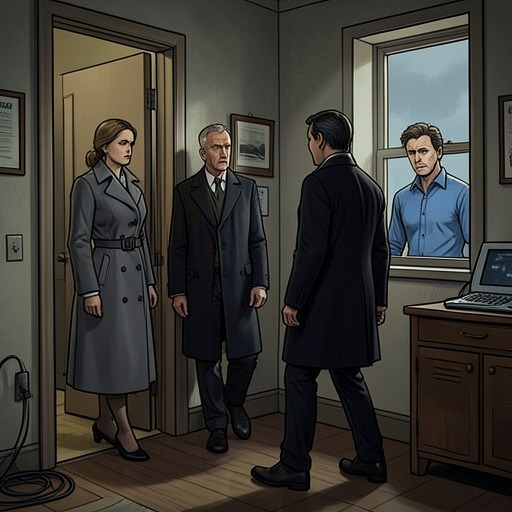
Detective Little contacts Anna by phone, reminding her that they met on Friday. In a separate exchange with detectives, Val Norelli points out that an email came from a Gmail address, which she says cannot be traced. She raises the possibility that Anna sent the message to herself. The discussion does not prove that Anna did so; it shows how the absence of a traceable sender allows her evidence to be recast as potentially self-generated.
The detectives’ playback of the 911 call offers a different kind of evidence: a recorded account that can be heard again and examined. Yet the recording preserves Anna’s report, not an independent confirmation of the identity of the person she saw or the events around the stabbing. The distinction matters because Anna’s account depends on identifying the woman as Jane, while the investigation is also testing whether that identification and the associated communications can be corroborated.
The Reported Disturbance at the Russells’ Home
Anna later asks Ethan Russell what happened when police came to the Russells’ home the following day. Ethan says he was in the kitchen and heard officers speaking with his parents in the living room. According to his account, police said someone had reported a disturbance the night before; his parents denied it. He says they then understood the matter as Anna’s word against theirs, with no one else having seen the woman.
This conversation reaches the reader through Ethan’s recollection, not through a direct account of the officers’ inquiry. Anna counters that David saw the woman and recalls that he spent four nights with her. The competing claims expose a practical problem for the investigation: a report can prompt police attention, but the force of that report depends on witnesses and evidence that others accept as relevant and credible.
Narrative Function
The NYPD’s appearances mark successive tests of Anna’s account rather than a settled resolution. The emergency call documents her alarm; the detectives’ questions examine the call and the traceability of a message; Ethan’s account of the visit to the Russells’ home presents a competing version of what police were told. Across these encounters, the record is real but incomplete, and each form of evidence carries a different limitation. The police therefore stand at the story’s boundary between private perception and public verification: their inquiries make Anna’s claims consequential while leaving their truth contested.